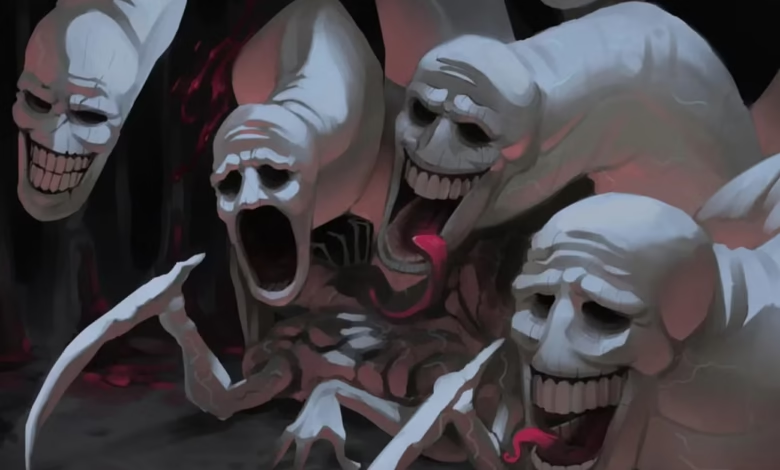
The false hydra is not just another monster you throw into a Dungeons & Dragons campaign. It is an experience. A psychological horror story disguised as a creature, designed to unsettle players, confuse characters, and slowly unravel the reality of the world they think they understand. Unlike dragons, liches, or demons, the false hydra does not rely on raw power or flashy abilities. Its true weapon is memory itself.
Dungeon Masters around the world consider the false hydra one of the most disturbing and memorable homebrew monsters ever created. It eats people, erases them from memory, and leaves behind a town that insists nothing is wrong while everything is clearly falling apart. When run correctly, a false hydra encounter becomes a campaign-defining moment that players talk about for years.
In this guide, we’ll explore exactly what the false hydra is, where it came from, how it works, and most importantly how to run it successfully in your D&D game without confusing or frustrating your players.
What Is a False Hydra?
A false hydra is a homebrew Dungeons & Dragons monster that feeds on humanoids while simultaneously erasing all memory of its victims. Anyone who hears its eerie song becomes incapable of noticing the creature or remembering anyone it has consumed. To those affected, the missing people simply never existed.
Physically, the false hydra is a pale, worm-like monstrosity that lives beneath towns or villages. It grows multiple long necks ending in distorted, human-like faces. These heads sing constantly, projecting a supernatural melody that suppresses awareness and memory.
The most terrifying part of the false hydra isn’t its appearance it’s the world it creates. A town where doors lead to empty rooms no one questions. A shopkeeper insists they’ve always lived alone, even though there are two beds upstairs. Children talk about imaginary siblings who no longer exist. Written records contradict spoken memories. Reality itself feels broken.
The Origins of the False Hydra
The false hydra originated as a piece of homebrew content created by the blogger Goblin Punch in 2014. It was never part of official D&D material, yet it spread rapidly through the tabletop role-playing community due to its originality and emotional impact.
What made the false hydra stand out was its focus on psychological horror instead of combat difficulty. Rather than challenging players with high armor class or massive damage, it challenged their assumptions about how the game world works. It encouraged Dungeon Masters to lie not maliciously, but narratively by omission.
Since then, the false hydra has been expanded, adapted, and reimagined by countless DMs. It has appeared in podcasts, video essays, homebrew manuals, and viral Reddit stories, becoming a modern legend within the D&D community.
Why the False Hydra Is So Effective
The false hydra works because it attacks the most basic trust at the table: the assumption that what the Dungeon Master describes is accurate. Instead of telling players they forget something, the DM simply never mentions it.
This creates horror through implication rather than explanation. Players begin to notice patterns that don’t make sense:
- Empty houses with signs of former occupants
- NPCs reacting emotionally to events they can’t explain
- Conflicting records, maps, or journal entries
- Missing party members no one remembers losing
The horror builds slowly. There is no jump scare. No dramatic reveal. Just an increasing sense that something is deeply wrong, even though no one in the world seems willing or able to acknowledge it.
The False Hydra’s Core Abilities
While many DMs customize the creature, most false hydras share the same essential traits:
- Memory Erasure: Anyone who hears the song forgets victims instantly and permanently
- Invisibility Through Ignorance: The hydra cannot be perceived while its song is active
- Underground Lair: It lives beneath settlements, feeding upward
- Multiple Heads: Each head can sing, attack, or observe independently
- Selective Silence: If the song stops, memories return all at once
These abilities are less about mechanics and more about narrative control. The false hydra doesn’t need complex stat blocks to be effective. Its true strength is how it reshapes the story.
Signs a False Hydra Is Present
A well-run false hydra encounter relies on subtle clues. The monster should never be obvious at first. Instead, players slowly piece together evidence that something unseen is consuming the town.
Common signs include:
- Mismatched furniture: Extra chairs, beds, or clothing that no one can explain
- Emotional gaps: NPCs grieving without knowing why
- Incomplete families: Portraits with scratched-out faces
- Unanswered questions: Letters addressed to people no one remembers
- Strange behavior: NPCs avoiding certain streets or basements
These details should feel natural, not highlighted. The more casually they are presented, the more unsettling they become.
How to Introduce a False Hydra in Your Campaign
The best way to introduce a false hydra is slowly and quietly. Do not announce it. Do not hint too strongly. Let the players discover inconsistencies on their own.
Start with a normal town. Friendly NPCs. Simple quests. Familiar routines. Then, over time, introduce small details that don’t quite add up. Maybe an innkeeper talks about closing rooms they “never use.” Maybe a shop has goods labeled for someone who doesn’t exist.
Most importantly, never tell players their characters forget something. Instead, remove references entirely. If a party member is eaten, stop mentioning them. Adjust encounters. Redistribute loot. Let the players feel the absence without understanding it.
Read Also: Katie Douglas Height, Age, Biography, Career & Personal Life Explained
Running the False Hydra Without Frustrating Players
The false hydra walks a fine line. When done well, it creates unforgettable horror. When done poorly, it can feel unfair or confusing. The key is balance.
Here’s how to keep it fun:
- Always leave clues: Confusion should lead somewhere
- Reward curiosity: Investigation should uncover truth
- Avoid permanent loss: Restore memories eventually
- Communicate after the reveal: Explain what happened
Players should feel tricked by the monster, not by the DM. Once the hydra is defeated or silenced, the flood of returning memories becomes one of the most powerful moments in the game.
What Happens When the Song Stops
The moment the false hydra’s song ends is the emotional climax of the story. Suddenly, everyone remembers everything. Loved ones lost. Friends eaten. Children erased from history.
NPCs may scream, collapse, or run through the streets in panic. The town is forced to confront the truth all at once. This is where the horror transforms into tragedy.
For players, this moment validates every strange detail they noticed. The confusion makes sense. The dread becomes real. It’s a payoff that few monsters can deliver.
Fighting the False Hydra
Combat with a false hydra should feel desperate and chaotic. The creature is massive, alien, and deeply unsettling. Even after it is revealed, it should not feel like a standard boss fight.
Use terrain creatively. The hydra’s necks can emerge from walls, floors, and streets. Heads can retreat underground. The battlefield should feel alive and dangerous.
More importantly, the fight should matter narratively. Killing the false hydra isn’t about loot or experience points it’s about saving what remains of the town and honoring those already lost.
Why the False Hydra Is a Modern D&D Classic
The false hydra has endured because it represents what tabletop role-playing does best. It tells stories that could not exist in books, movies, or video games. Stories built on trust, imagination, and shared reality.
It turns memory into a mechanic, absence into a clue, and silence into a weapon. It proves that the scariest monsters aren’t always the ones with the biggest claws but the ones that make you doubt your own perceptions.
For Dungeon Masters willing to take the risk, the false hydra offers something rare: a chance to create a moment your players will never forget, even if their characters do.
Final Thoughts on the False Hydra
The false hydra is not for every table, but for the right group, it can be transformative. It demands patience, subtlety, and confidence from the DM. It asks players to engage deeply with the world rather than simply react to it.
If you’re looking for a monster that goes beyond combat and challenges the very idea of storytelling in D&D, the false hydra is unmatched. Run carefully, reveal thoughtfully, and trust your players to rise to the experience.
When done right, the false hydra doesn’t just haunt your campaign it stays with your group long after the dice stop rolling.